





News Nanoseconds, Rabbits and Fishing Rods. What Did Two Days at the CESNET Conference Bring?
Nanoseconds, Rabbits and Fishing Rods. What Did Two Days at the CESNET Conference Bring?
 5. October 2026
How precisely can time be synchronised between two locations hundreds of kilometres apart? What can artificial intelligence do today to defend computer networks, and where are the technologies underpinning academia heading? Held in Prague on 30 September and 1 October, the CESNET Conference showcased the latest developments in e-infrastructure through specific services, technologies and real-world experience. One of the key announcements was the launch of CESTime, CESNET’s new service for distributing precise time with nanosecond-level accuracy.
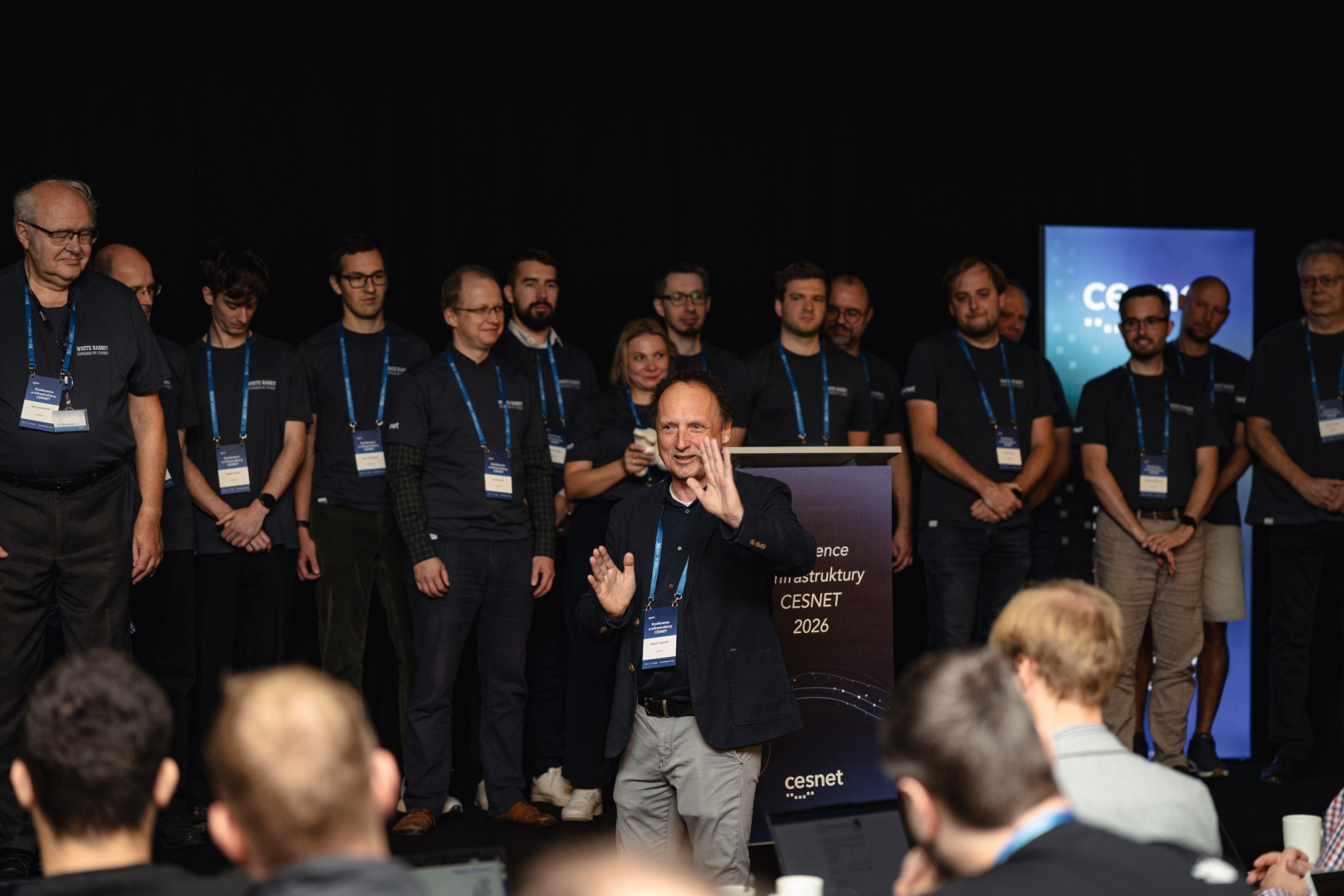
The conference was opened by Jakub Papírník, Director of CESNET, who began by emphasising that behind the technologies, services and the CESNET name itself are, above all, people. “Everything that is created and operated under the CESNET name is the work of real people – our colleagues as well as people from the institutions we work with. It is their work and expertise that give CESNET its true substance, and they deserve our sincere thanks,” Papírník said in his opening remarks.
The first day of the conference then offered a broad overview of CESNET’s current activities and future direction. The programme covered the development of the CESNET3 hybrid network, research activities and their transition into practical applications, e-infrastructure services, and solutions for processing and storing large volumes of data. It also presented developments in authentication and authorisation, cybersecurity and multimedia, as well as projects supported through the CESNET Development Fund. One of the central topics was the launch of the CESTime infrastructure and service for distributing precise time over optical networks. The solution uses White Rabbit technology developed at CERN and enables nanosecond-level synchronisation independently of global navigation satellite systems such as GPS or Galileo. CESNET is thus building on its long-standing research into precise time transfer, bringing a technology previously tested both in laboratory conditions and in real-world network infrastructure into operation as a service.
“We are building CESTime as a network running in parallel with the internet, using separate optical channels dedicated exclusively to the transmission of timing protocols. The signal travels in one direction from CESNET’s atomic clocks, which are linked to the Czech national time standard. This allows us to provide users with highly precise time through infrastructure that operates independently of regular internet traffic,” explained Vladimír Smotlacha, CESNET’s representative in the White Rabbit Collaboration. The first day also demonstrated the breadth of areas covered by CESNET’s e-infrastructure today. Alongside the network infrastructure itself, the programme addressed MetaCentrum computing capacities, data storage and the National Repository Platform, digitalisation and security. A series of lightning talks also introduced projects supported by the CESNET Development Fund, including the ENVision platform for analysing natural ecosystems using aerial and satellite data, options for digitising physical NFC identification cards in university environments, and the Knowledge on Demand project.
On Day Two, Phishingator Cast the Line – While Other Topics Went Deeper
While the first day provided a broad overview of CESNET’s current activities and future direction, on 1 October the programme split into specialised thematic sessions and workshops that explored individual topics in greater depth. The research and multimedia programme followed up on the previous day’s introduction of CESTime with topics related to White Rabbit technology and ultra-stable transmission, while also covering quantum key distribution (QKD), fibre-optic sensing and the use of 5G networks. The afternoon shifted towards multimedia, ranging from videoconferencing security to 3D digitisation and visualisation of cultural heritage and low-latency transmission enabling remote collaboration.
A dedicated security track focused on current approaches to protecting large-scale network infrastructures. It presented the development of CESNET’s network defence capabilities as well as the use of artificial intelligence in security monitoring, including its application in the RETINA collector. Other topics included network infrastructure management automation, DNS protection and current developments in digital certificates. The programme also addressed the EU Digital Identity Wallet, a digital wallet that European Union Member States are expected to make available to citizens by the end of 2026. Practical experience from universities was presented through talks on passwordless authentication at the University of West Bohemia and methodological support for log management at Masaryk University.
The Phishingator workshop focused on a service that helps institutions test their users’ resilience to phishing attacks. The programme also covered current trends in phishing and social engineering and included a panel discussion on practical experience. In addition to security, research and multimedia, the second day also focused on MetaCentrum and data storage. The specialised sessions thus built on the topics introduced during the first day, providing space for a more detailed look at technologies and services as well as practical experience with their real-world use.
Photo gallery